The Number Hidden in Your Walls: The Six-Fold Dimensional Test
Everything so far has been about where things sit. This grid is different. It says a building can be flawlessly arranged — every room in its element, the doorway in a perfect gate — and still carry a dosha, because of nothing more than its dimensions. The measurements of a structure are run through a six-fold calculation, and the number that falls out decides whether the size itself is auspicious. Placement is geometry; this is arithmetic.
Article 7 of the Vastu Diagnostic Grids series.
This is the grid outsiders almost never hear about, because it doesn't show up on a floor plan the way a badly placed kitchen does. It lives in the tape measure. The tradition holds that a building's length, breadth, and the perimeter they create carry a vibration of their own — and it developed a precise six-fold test to read it.
The six values
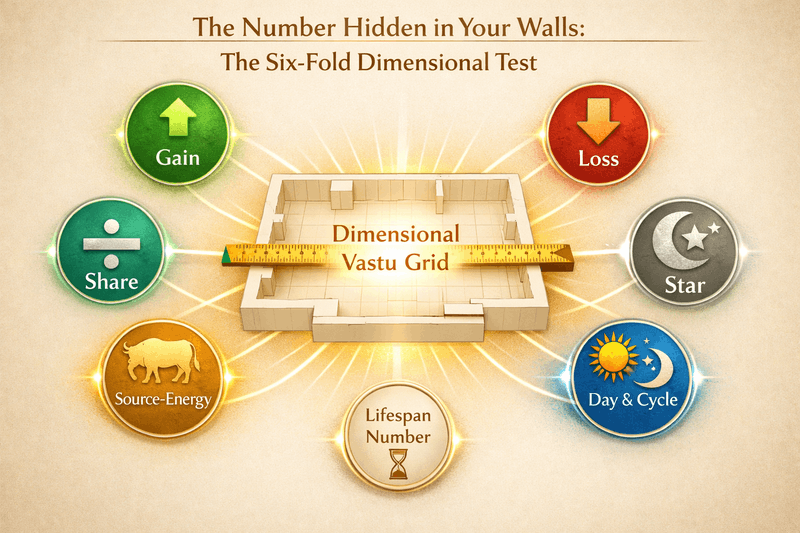
The core method takes the building's key dimension and passes it through six derived readings. Each looks at the same structure from a different angle:
- The gain value — the "income" a set of dimensions is said to generate. You want this strong, and facing its own favourable direction.
- The loss value — the "expenditure" the same dimensions carry. You want this small relative to the gain.
- The share value — how the dimension divides, read for whether it lands on a supportive or an adverse portion.
- The star value — the dimension mapped onto the lunar mansions, tested for a favourable or unfavourable star.
- The source-energy value — an animal "nature" assigned to the dimension, which should be compatible with the building's purpose and its occupants.
- The day-and-cycle value — the dimension tied to a weekday and lunar phase, checked for fit.
Run together, these six give a single verdict: do the numbers of this building support the life inside it, or fight it? The guiding preference is consistent — gain over loss, the favourable side over the adverse, compatibility over conflict.
Why size can be a defect on its own
The point that surprises people is that this is independent of placement. Two houses can have identical layouts — same rooms, same directions, same doorway — and read differently because one is a few units longer than the other, tipping its calculation from a favourable value to an adverse one. On this grid, the fault is not "the kitchen is in the wrong corner." It is "the building is the wrong size."
This is also why the tradition treats the ratio of a building so seriously — a length that runs too far beyond its breadth doesn't just look wrong, it pushes the dimensional reading into unfavourable territory. Proportion isn't aesthetics here; it's arithmetic with consequences.
The lifespan reading
The same dimensional logic produces one more figure the tradition takes seriously: a notional lifespan for the structure — a number derived from the building's own measure, marking the span over which it is considered to hold its vitality before it is meant to be renewed or re-consecrated. It's best understood not as a countdown but as the tradition's way of saying that a structure has a natural life-cycle written into its proportions, and that renewal is part of the design, not an afterthought.
The honest scope of it
Two things keep this grid grounded. First, it was meant for substantial, purpose-built structures measured in the traditional units — not for every shed, ornament, or minor extension. Second, it is a specialist calculation: unlike the elemental wheel, which anyone can learn to read, the dimensional test is the part of Vastu that genuinely requires careful working, because a small error in the measure changes the result. It's a grid you commission, not one you eyeball.
How a reader uses it
For a building being designed or evaluated
- Take the key dimensions in the correct measure.
- Run the six values and read the verdict — gain against loss, favourable against adverse, compatible against conflicting.
- Adjust the size, not the layout, to fix it — nudging a dimension until the calculation lands well is often the cleanest correction, because it changes nothing about how the space is used.
- Note the lifespan figure as a marker of the structure's natural cycle of renewal.
The takeaway
Not every dosha is about where something sits. The six-fold dimensional test says a building's very measurements carry fortune or friction — gain and loss, star and source-energy, day and cycle — and that a structure can be perfectly arranged yet numerically off. It's the quiet, arithmetical grid beneath the visible ones, and the reason a serious Vastu design starts at the drawing board with a calculator, not just a compass.
Next in the series: the grids that read the sky instead of the building — the timing wheels that decide when and where to begin.
Keywords & Associations
Aya Vastu, dimensional Vastu, six-fold calculation, gain and loss, building measurements, proportion Vastu, length breadth ratio, lifespan of a house, numerical Vastu, source energy, lunar mansion, Vastu dosha, building size, classical Vastu, measurement test, auspicious dimensions, home vibration, structural Vastu.