The 32 Gates: How the Doorway Alone Can Make or Break a Home
Vastu calls the main door the mouth of the house — the single opening through which everything enters. And it is not judged by direction alone. The boundary of the grid is divided into thirty-two precise positions, each with its own result, and exactly which one your front door lands on is one of the most heavily weighted readings in the entire system. Two doors on the same wall, a metre apart, can carry opposite fortunes.
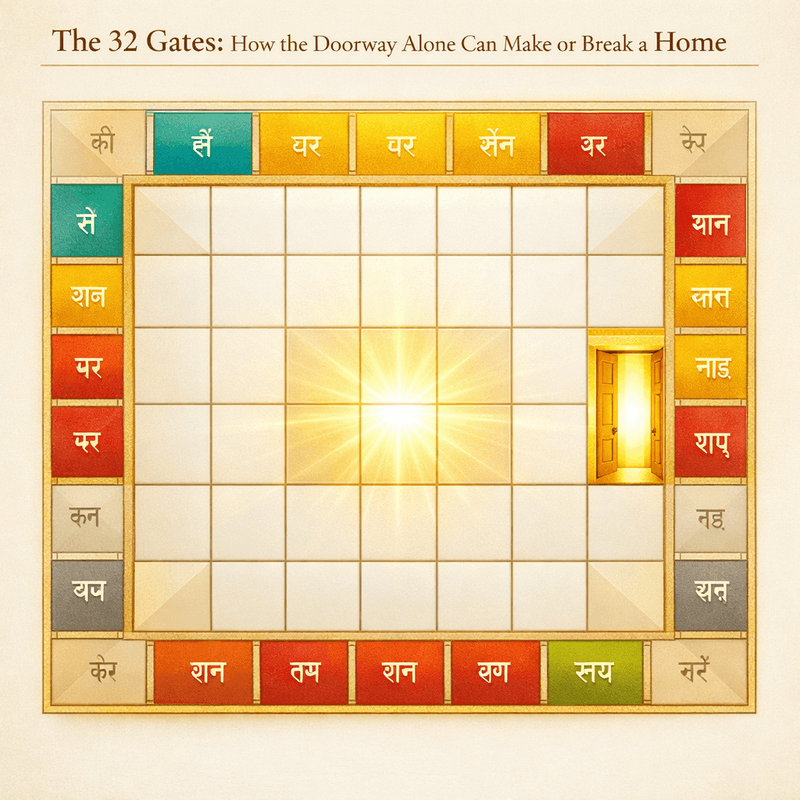
Article 6 of the Vastu Diagnostic Grids series.
Most people know the coarse version: east door good, south door to be avoided. That's true as far as it goes, but it's the beginner's map. The real reading is finer. Of the forty-five energies in the master grid, the thirty-two that ring the boundary are the ones that govern the doorway — and each wall is divided among them. The door doesn't just face a direction; it occupies a position, and the position is what's read.
Why the door carries so much weight
The doorway is the throat of the whole grid. Every other feature is internal — a room, a weight, a void — but the door is where the outside world crosses into the plan. In the tradition's logic, a well-placed mouth nourishes the entire body, and a badly placed one poisons it slowly. This is why a single door can outweigh several smaller faults elsewhere, and why correcting an entrance is often the first move a reader makes.
How the thirty-two positions work
Each side of the plan is divided into equal segments, and the boundary energies are seated along them in order. To read a door:
- Take the wall the door sits on.
- Divide that wall into its segments.
- See which segment — which energy — the door's centre falls on.
- Read the result for that position.
Because the segments are narrow, small shifts matter. Moving a door one segment along a wall changes which energy it sits on, and therefore changes the reading entirely. This precision is exactly what separates a proper entrance analysis from a vague "which direction is my door."
The favourable and the flagged
Along the thirty-two positions, some are strongly benefic, some are strongly adverse, and the rest are neutral. Without naming every cell, the pattern is consistent:
- A handful of positions on each of the auspicious walls are the sweet spots — associated with gain, prosperity, standing, and good fortune. These are the positions a reader steers a door toward.
- Several positions carry hard results — associated with conflict, loss, drain, or ill health — and a door on one of these is the classic entrance dosha.
- A few structural rules override the position entirelya door in the exact centre of a wall is avoided, and so is a door jammed hard into a corner. The good positions sit in between.
The takeaway is not to memorise thirty-two names but to understand the shape: a narrow set of excellent spots, a scatter of bad ones, and precision mattering down to the segment.
The door has more than a position
A full entrance reading layers a few more checks on top of the thirty-two gates:
- Direction quality — the broad east-best, north-good, west-workable, south-guarded ranking still applies as the backdrop.
- What faces the door — an obstruction standing directly opposite the entrance (a pole, a corner, a tree, a straight road aimed at it) is a fault of its own, distinct from the position.
- The turn on entering — whether movement flows in cleanly or is forced against itself as you cross the threshold.
- Proportion — the main door being the largest and best-made opening, not outshone by a lesser one.
But underneath all of it sits the position on the grid. Get the mouth in one of the good cells, and the rest of the entrance reading has a strong foundation.
How a reader uses it
On an oriented plan with the door's exact placement known
- Fix which wall and which segment the door occupies.
- Read the position — is it one of the benefic cells, one of the adverse ones, or neutral?
- Rule out the two structural faults — dead-centre of a wall, or hard into a corner.
- Layer the extras — direction, what faces it, the entry flow.
Where a door already sits on a poor position and can't be moved, the corrections work on what can change — the facing obstruction, the flow, the proportion — while the underlying position is noted honestly for what it is.
The takeaway
The doorway is the mouth of the house, and Vastu reads it with surgical precision: thirty-two positions around the boundary, each with its own result, with the exact segment your door occupies deciding the verdict. A narrow band of positions is excellent, a scatter is adverse, and the centre and corners of a wall are avoided outright. Before you worry about any room, find out which of the thirty-two gates you're actually living behind.
Next in the series: the fault that has nothing to do with placement and everything to do with size — the number hidden in your walls.
Keywords & Associations
thirty-two gates, entrance Vastu, main door position, boundary deities, door direction, east door, mouth of the house, Vastu dosha, doorway reading, dvara vedha, entry flow, door proportion, favourable door, adverse door, Vastu Purusha Mandala, home entrance, floor plan Vastu, classical Vastu, door placement.