Sixteen Zones, Nine Planets, One Body: The Modern Remedy Engine
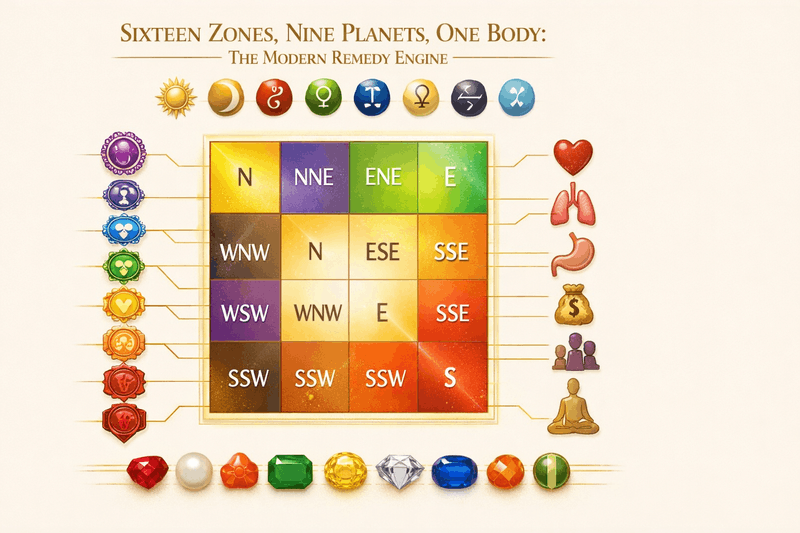
Finding a fault is one thing. Knowing exactly what cures it is another. This is the grid that made modern Vastu so quick to apply: it maps each of the sixteen zones of a home to a planet, an energy centre of the body, an organ, a life-area, and a specific remedy — a colour, a metal, a stone. Point to the troubled zone, read across the table, and out comes the cure. It's the closest thing Vastu has to a lookup engine.
Article 10 of the Vastu Diagnostic Grids series.
The heavy-light key tells you where a home is out of balance. This grid tells you what it means and how to fix it. Modern practice built a dense correspondence table, running each of the sixteen zones across several columns at once — and it is this table that lets a reader move in one step from "the defect is in this zone" to "apply this remedy."
The columns of the table
For each of the sixteen zones, the modern system reads several linked things:
- A ruling planet. Every zone is tied to one of the classical planets, lending it that planet's nature — discipline, drive, charm, expansion, and so on.
- An energy centre of the body. Each zone corresponds to one of the body's subtle centres, connecting the space to a layer of health and temperament.
- An organ or body part. The zone maps onto a specific region of the body, which is how a defect there is read as touching that part of the residents' health.
- A life-area and a person. Each zone governs a domain — money, relationships, reputation, mental peace — and often a particular member of the household.
- A remedial signature. And crucially, each zone carries its own corrective — a colour that steadies it, an element to add or withdraw, a stone or metal associated with its planet.
Read a single row across and you have a complete picture: this zone is ruled by this planet, tied to this centre and organ, governs this part of life, and is settled by this remedy.
How it turns a fault into a cure
This is the grid's whole value. The other maps diagnose; this one prescribes. The workflow is almost mechanical:
- 01Locate the troubled zone — using the heavy-light key and the sixteen-zone split.
- 02Read its row — planet, centre, organ, life-area.
- 03Apply the mapped remedy — introduce the zone's steadying colour, correct its element, place its associated material, or lighten or clear what's overloading it.
So a disturbance in one zone might call for cooling and opening it; another for a specific colour to calm an over-active planet; another for adding weight or withdrawing water. The remedy isn't invented on the spot — it's read off the correspondence.
The health layer, read responsibly
Because each zone links to a body centre and an organ, this grid is also where Vastu makes its health associations — a defect in a given zone is read as pressing on the part of the body that zone governs. This is powerful as a diagnostic language, but it deserves a clear head: these are the tradition's symbolic correspondences between space and body, a way of describing which area of life a fault touches — not medical diagnoses, and never a prediction that a placement will cause a specific illness. Used well, the health column tells you which theme a zone carries. It should never be used to frighten anyone about their home. A responsible reading names the association and moves straight to the remedy.
The strength of a lookup, the limit of one
The genius of this grid is repeatability: two readers with the same table reach the same remedy, which is why modern Vastu spread so fast and travels so well. The limit is the flip side — a table is only as good as the judgement applied to it. A zone can be ruled by a difficult planet and still be perfectly fine if the space is used well, and no correspondence replaces reading the whole home. The engine gives you the candidate cure; judgement decides whether it's needed and how far to take it — always gentlest first.
How a reader uses it
Over an oriented plan with the sixteen zones marked
- Identify which zones carry a defect.
- Read each troubled zone's row — planet, centre, organ, life-area.
- Match the remedy — colour, element, material — to the zone.
- Prioritise — treat the zones tied to the home's heaviest themes first, and start with the lightest corrections that address them.
The takeaway
This is the grid that made modern Vastu practical: sixteen zones, each mapped to a planet, a body centre, an organ, a life-area, and a specific cure. It turns diagnosis into prescription — point to the fault, read across, apply the remedy. Treat its health column as symbolic language rather than medical fact, keep judgement in the loop, and correct gently, and you have the fastest, most repeatable tool in the whole Vastu kit.
Next in the series, the final grid — and the newest of all: the invisible energy lines running through the earth beneath your floor.
Keywords & Associations
Vastu remedies, sixteen zones, planets and directions, chakra Vastu, body zones, zone effect, colour remedy, Vastu cure, planetary Vastu, energy centres, life areas, modern Vastu, Vastu dosha, remedy engine, directional health, home correction, floor plan Vastu, symbolic correspondence, gemstone remedy.