The Serpent, the Calf, and the Bull: The Timing Wheels of Vastu
Every grid so far reads the building. This family of grids reads the sky. Before a shovel breaks ground, the tradition asks a different question — not "where is the fault?" but "is this the right moment, and the right corner, to begin?" It answers with three moving figures: a cosmic serpent, a calf, and a bull, each turning through the directions with time. Build in step with them, and the work is blessed. Cut across them, and the beginning itself is a dosha.
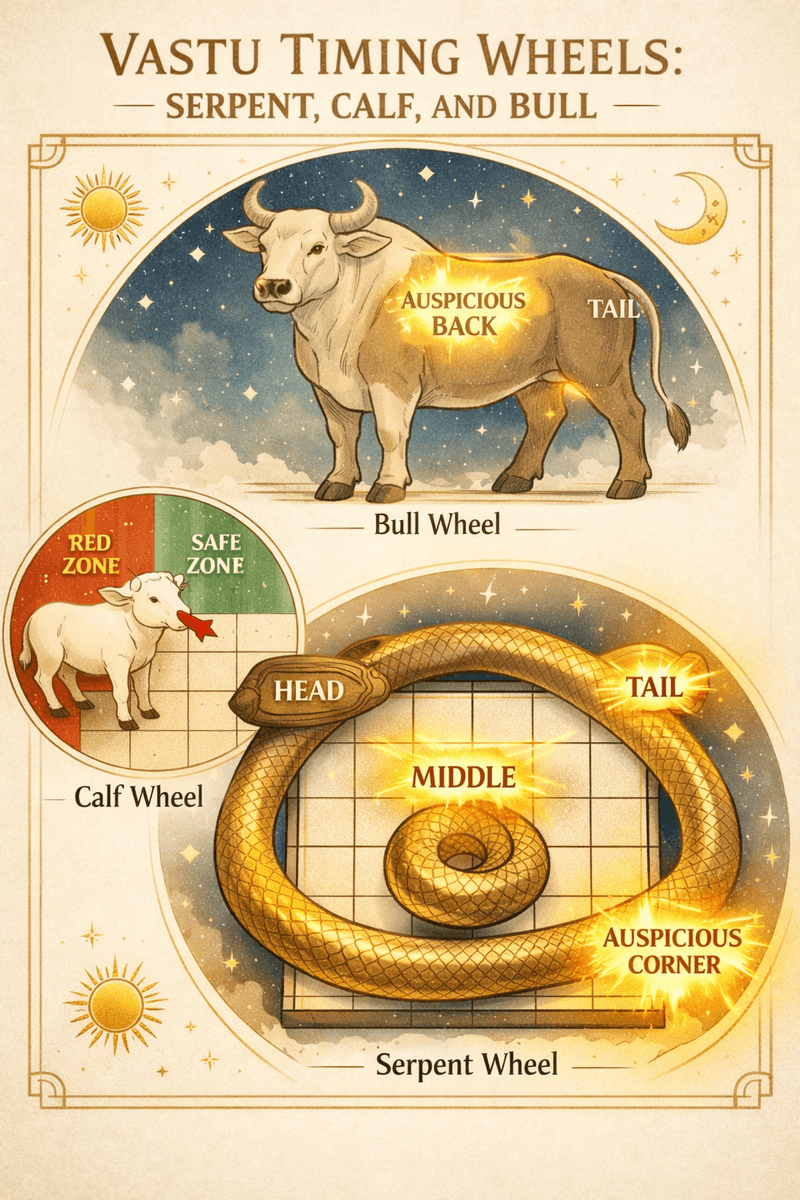
Article 8 of the Vastu Diagnostic Grids series.
The grids we've covered are spatial — they judge a structure that already exists or is being drawn. The timing wheels are temporal. They govern the act of beginning: which corner to dig first, which day to lay the foundation, when to first step across the threshold. The idea is that a building is not only a place but an event, and an event has an auspicious moment written into the turning sky.
The serpent: which corner to break first
The first wheel is a cosmic serpent that lies coiled across the plan and shifts its position with the season, following the sun. At any given time its mouth, its middle, and its tail occupy three of the corners — leaving one corner empty.
The rule is exact: break the first ground in the empty corner. Never begin on the mouth, the middle, or the tail.
- Digging on the empty corner → the foundation is auspicious; the household prospers.
- Digging on the mouth → the harshest reading, touching the elders of the family.
- Digging on the middle → trouble and obstruction.
- Digging on the tail → loss and instability for the line.
Because the serpent moves through the year, the "safe" corner to start from is not fixed — it must be read for the time of building. This is the wheel that decides the very first act of construction.
The calf: which way not to face
The second wheel is a calf whose mouth points in one direction for a season at a time, then turns. The instruction is about orientation of the act:
- Do not dig, install, or first enter while facing the calf's mouth — that alignment is read as a loss.
- Behind it is a lesser fault; to its sides is favourable.
Where the serpent governs the corner, the calf governs the facing — the direction you work toward as you begin.
The bull: reading the moment itself
The third wheel maps the moment onto the body of a bull. Counting through the lunar mansions from the sun's position to the moon's places the chosen time on a part of the bull — and each part carries a result:
- The back is the most auspicious spot — fortune and prosperity.
- A stable foot reads as long, settled residence.
- The head carries a fire-warning; the tail and certain limbs carry hard results.
The bull is the finest of the three — it reads not just where or which way, but when, tuning the exact timing of the beginning to the sky.
Why timing counts as a grid at all
It's fair to ask why this belongs alongside the spatial grids. The answer is that in this tradition a defect is any violation of an overlaid map — and the timing wheels are maps too, just drawn on the calendar instead of the floor plan. To begin a building on the serpent's mouth, or facing the calf, or on an adverse part of the bull, is to start out of alignment with the moving sky — and that misalignment is read as a dosha carried by the structure from its very first day. It is the one class of Vastu fault you cannot fix later by moving anything, because it lives in the beginning, not the layout.
How a reader uses it
For a build about to start
- Read the serpent for the season and identify the empty corner — begin there.
- Read the calf and avoid working toward its mouth as you break ground.
- Read the bull to tune the exact moment to a favourable part of its body.
- Combine with the general timing rules — an auspicious phase of the moon, a supportive weekday, a clear sky — to fix the foundation moment.
Because these wheels turn, they are read fresh for each project; there is no permanent "good corner" or "good day." That's the whole point — the sky has moved.
The takeaway
Vastu doesn't only ask where the fault is; it asks whether the beginning was in step with the turning sky. A serpent that names the corner to break first, a calf that names the direction to avoid, a bull that tunes the very moment — three moving grids that judge the event of building rather than the building itself. It is the one dosha that can never be remedied after the fact, which is exactly why the tradition reads it before the first shovel moves.
Next in the series: we cross into modern Vastu, and the single master key it runs almost everything on — heavy and light.
Keywords & Associations
Vastu timing, muhurta, serpent chakra, calf chakra, bull chakra, foundation direction, first digging, auspicious beginning, breaking ground, directional timing, lunar mansion, when to build, Vastu dosha, cosmic wheels, construction start, classical Vastu, foundation muhurta, sky timing, home construction.