The Points You Must Never Pierce: The Vital Nerve-Points of a Building
Acupuncture has its pressure points. A building, in Vastu, has the same — vital junctions woven invisibly through the plan where its energy lines cross. Drive a column, a beam, a wall, or a heavy load through one of them, and you have committed one of the most serious faults in the entire tradition. They are called marma, and most homes have never even been checked for them.
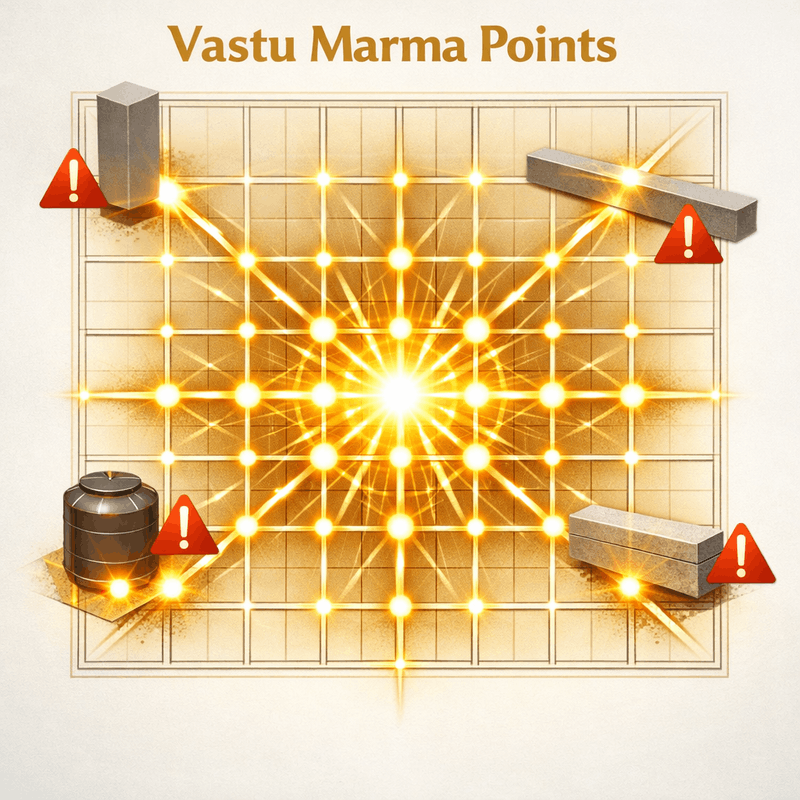
Article 4 of the Vastu Diagnostic Grids series.
We've laid the master grid and animated it into a cosmic body. Now trace the nervous system of that body. Just as the human form has vital points where nerves, vessels, and joints converge — spots that are dangerous to injure — the figure lying across your plot has the same. In Vastu these are the marma points, and protecting them is a discipline all its own.
What a marma actually is
A marma is a crossing point — a place where the invisible lines running through the grid meet. Two kinds of line create them:
- The energy channels that run along and across the body of the plan (its "veins," in the traditional image).
- The diagonals that run corner to corner across the grid.
Wherever these lines intersect, a marma forms. The rule is simple and strict: a marma must stay unpierced. Nothing structural and heavy — no wall, no pillar, no beam, no column footing — should land on one.
The hierarchy of vital points
Not all vital points carry equal weight. The tradition grades them:
- The great vital points — a small set corresponding to the figure's most critical organs: the head, the heart, the navel, and the points at the crown of the trunk. These are the ones guarded most jealously.
- The super-vital points at the centre — where the main diagonals and channels all converge inside the sacred core, a cluster of the most powerful junctions in the whole plan. This is the reason the centre of a home is kept clear: it is not one sensitive spot but a knot of them.
- The wider field of vital points spread across the rest of the grid, each a smaller junction to be respected.
The closer a marma is to the centre, and the more lines that cross there, the more serious it is to pierce.
What "piercing" means — and why it matters
A marma is pierced when a hard structural element sits directly on it:
- A load-bearing pillar planted on a junction.
- A beam or wall running straight through one.
- A heavy fixed load — a staircase, a water tank, a massive storage mass — pressing down on a cluster of them.
The tradition's reasoning is that a vital point must stay free — open for the building's energy and light to move through, exactly as a nerve-junction must stay uncompressed for the body to function. Block it, and the flow the whole grid depends on is choked at its most sensitive place. This is the deeper reason behind two rules you've heard a hundred times without the "why": keep the centre open, and don't run a beam or column through the middle of the house. Both are marma protection.
How a reader uses it
Marma analysis is done on an oriented plan by tracing the lines and watching where structure lands:
- Map the crossing points — the diagonals and the main channels — and mark every intersection.
- Check what sits on each. A column footing, a wall junction, or a heavy fixed load on a marma is flagged at once.
- Guard the centre above all. The convergence of junctions in the core means anything heavy or wet placed there pierces not one point but many.
- Design around them, not through them. Where an existing structure already pierces a marma, the correction is to relieve the load — lighten it, open it, shift the heavy element off the point.
The takeaway
A building has vital points exactly as a body does — crossings of its energy lines, graded from minor junctions to the powerful cluster at the centre. Piercing one with a pillar, beam, wall, or heavy load is treated as a serious fault, and it is the real logic behind the oldest instruction in Vastu: keep the heart of the home open and unburdened. Before you judge any room, find the points that were never meant to be touched.
Next in the series: the wheel most people think is all of Vastu — eight directions, five elements, and one sacred centre.
Keywords & Associations
marma points, Vastu vital points, energy lines, nadi, diagonals, Brahmasthan, super-vital points, marma vedha, piercing, central pillar, beam Vastu, load bearing, keep centre open, Vastu dosha, structural defect, home energy flow, classical Vastu, floor plan analysis, sacred centre, building nerve points.