The Diagnostic Grids of Vastu: How a Home's Doshas Are Really Found
Most people think Vastu is a bag of superstitions — a kitchen here, a toilet there, a mirror on the "right" wall. It isn't. Underneath every genuine reading sits a set of invisible grids laid over your home, and a dosha is simply a feature that lands in the wrong cell of one of them. Learn the grids, and Vastu stops being folklore and starts behaving like a diagnostic system.
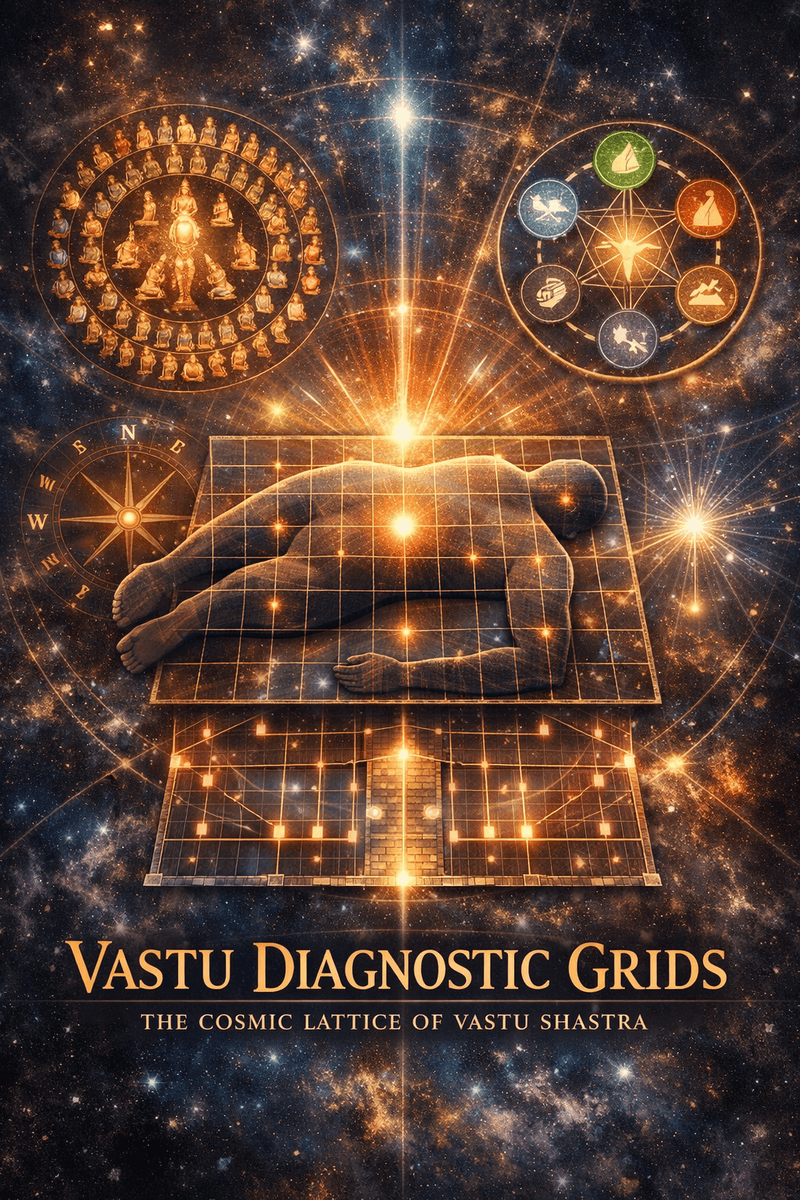
Article 1 of the Vastu Diagnostic Grids series.
A skilled reader never guesses. They take your plan, fix its true directions, and then lay one map after another over it — a grid of deities, a cosmic body, a web of nerve-points, a wheel of elements, a ring of gates. A defect is not a vibe. It is a measurable violation: a heavy mass sitting where the map wants openness, a doorway on the wrong cell, a beam driven through a vital point. Once you see the grids, you can see exactly why a room is flagged and exactly what would clear it.
This series walks each grid in turn. Here is the whole toolkit at a glance.
The classical foundation
The master grid and its 45 deities. The plot is squared into a lattice of cells, and forty-five presiding energies are seated across it — thirty-two around the boundary, thirteen within, and the creative principle holding the centre. Every cell carries a character, so a wall, a door, or a weight is read through the energy of the cell it occupies. This is the parent grid; everything else is drawn on top of it.
The cosmic body in your floor plan. The same grid is a body — a figure lying face-down with its head in the north-east and its feet in the south-west. Each cell is a body part, which is how the tradition links a physical fault to a bodily result: disturb a limb-cell, and the disturbance is read in that same limb of the household.
The points you must never pierce. Woven through that body are vital points — the nerve-junctions of the building — where its energy lines cross. Driving a column, a beam, a wall, or a heavy load through one of these is treated as one of the most serious faults there is.
Eight lords, five elements, one sacred centre. The coarse, everyday lens: eight directions, each with a ruling energy and an element — water in the north-east, fire in the south-east, earth in the south-west, air in the north-west, and pure space at the centre. Put a function where its element belongs and it thrives; put it against its element and you have a dosha.
The thirty-two gates. The doorway is the mouth of the house, and the boundary of the grid is divided into thirty-two positions, each with its own result. Which position your main door occupies is one of the most heavily weighted readings in the whole system.
The number hidden in your walls. Placement is only half of it. The building's measurements are run through a six-fold calculation that tests whether the dimensions themselves are auspicious — a defect that has nothing to do with where anything sits and everything to do with the size of the structure.
The timing wheels. A separate family of grids governs when and where to begin — which corner to break first, which day to lay the foundation — reading the sky's moving figures rather than the building's fixed ones.
The modern layer
Heavy and light. Contemporary practice compresses much of the above into a single master rule: keep the south-west heavy and high, the north-east light and open, and let the ground fall from one to the other. Most modern faults are just weight, height, water, or a void in the wrong quarter.
The remedy engine. Modern Vastu maps each of sixteen zones to a planet, an energy centre of the body, an organ, and a specific remedy — a colour, a metal, a stone. This is what lets it move straight from "the defect is here" to "this is what fixes it."
The invisible earth grids. The newest overlay of all: subtle energy lines running through the ground itself, whose crossing-points are treated as stress spots — found not by scripture but by dowsing.
How they work together
No single grid decides anything. A real reading stacks several at once: orient the plan, lay the deity-grid and its body, protect the vital points, test every room against its element and the heavy-light rule, weigh the doorway against the thirty-two gates, and — classically — check the dimensions. A dosha is a feature that breaks one or more of these maps. A remedy is whatever restores the broken map, and the honest order is always gentlest first: change how a room is used, clear the centre, lighten the north-east — long before anyone reaches for a hammer.
Read this series and you will never look at a floor plan the same way again. You'll stop asking "is this good or bad?" and start asking the real question: which grid is this breaking, and how far?
Each grid gets its own deep dive next. We begin where every reading begins — with the master grid and its forty-five deities.
Keywords & Associations
Vastu Shastra, Vastu dosha, Vastu Purusha Mandala, 45 devatas, marma points, Brahmasthan, eight directions, five elements, Ishaan, Agneya, Nairutya, Vayavya, thirty-two gates, entrance Vastu, Aya, dimensional Vastu, heavy and light, sixteen zones, geopathic stress, energy lines, Vastu remedies, classical Vastu, modern Vastu, floor plan analysis, directional grid, home diagnosis.