The 45 Devatas: The Master Grid Every Vastu Reading Begins With
Before a single room is judged, a Vastu reading draws one thing: a lattice of cells across your plot, with forty-five living energies seated inside it. This is the master grid — the one map from which every other diagnostic is derived. Miss it, and everything downstream is guesswork.
Article 2 of the Vastu Diagnostic Grids series.
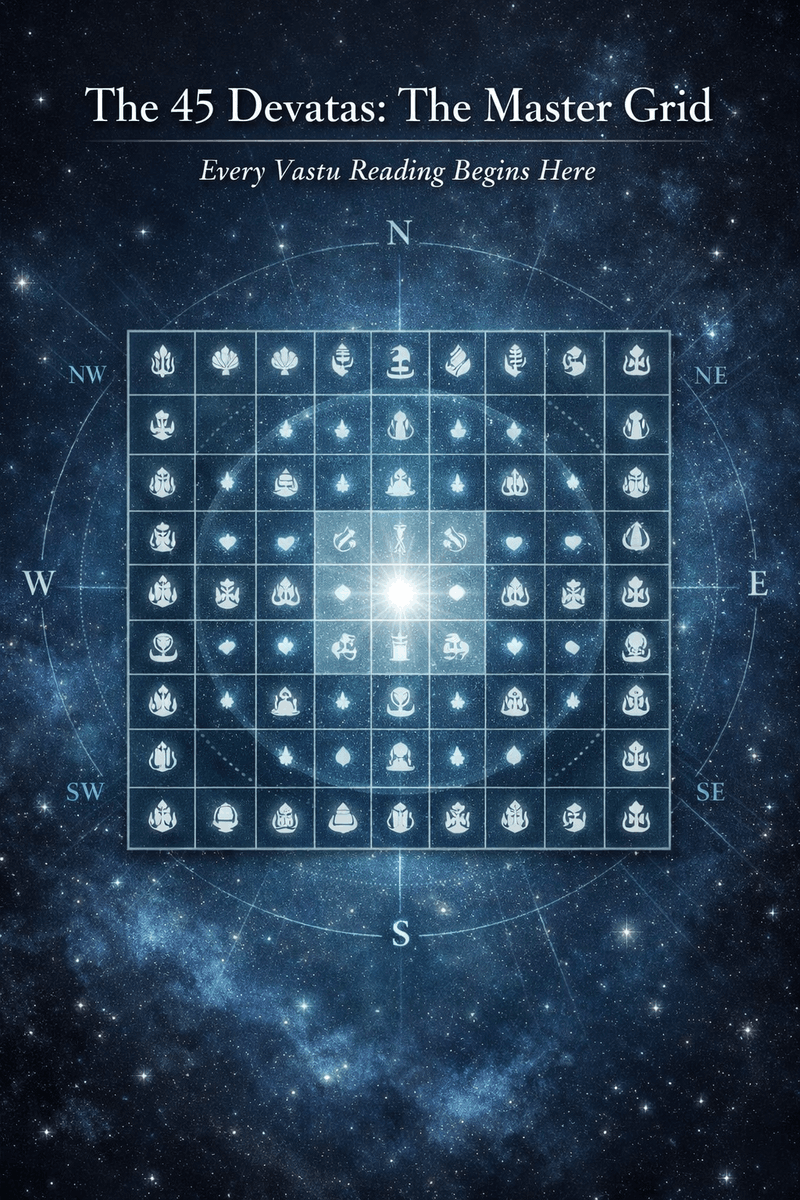
Ask most people what Vastu is and they'll list rules — kitchen in the south-east, no toilet in the north-east. But those rules are conclusions, not causes. The cause is a grid. The tradition takes the square of your land, divides it into equal cells, and populates it with forty-five presiding energies, each with a distinct character. Every wall, door, weight, and void is then read through the energy of the cell it happens to occupy. That is the whole engine.
The grid changes with the purpose
The lattice is not one fixed size. Its cell-count is chosen for what you are building:
- A home is set on an eighty-one-cell grid (nine by nine).
- A village or town uses a sixty-four-cell grid.
- A temple uses a hundred-cell grid.
- A renovation of an existing structure uses a smaller forty-nine-cell grid.
- A well, tank, or reservoir uses a very fine one-hundred-ninety-six-cell grid.
The principle is that the more sacred or complex the structure, the finer the mesh through which it is read.
Forty-five energies, in three rings
However many cells the grid has, the same forty-five presiding energies are distributed across it, and they fall into a clear order:
- The centre belongs to the creative principle — the source-energy that holds the innermost cells. In the home grid it commands the central nine, forming the sacred core of the whole plan.
- Four great energies sit around that core in the four cardinal directions, each governing a broad band.
- Eight corner energies occupy the inner diagonals.
- Thirty-two boundary energies ring the entire outer edge — and it is these thirty-two that later decide the doorway (a grid of their own, covered elsewhere in this series).
Thirty-two on the rim, thirteen within: forty-five in all.
The four rings of sensitivity
The grid is not uniformly "important." Read from the outside in, it forms four concentric belts, and each is treated with a different hand:
- The outer ring (the boundary cells) is the coarsest zone — traditionally kept open, the strip along the compound wall.
- The next ring in is the human zone, where ordinary living and building belong.
- The ring after that is the zone of the higher energies — treated with more care.
- The central core is the most sensitive ground in the entire plan and is meant to stay light and uncluttered.
This is why a defect is never judged in isolation. The same fault — a heavy load, say — is minor near the outer ring and grave near the core. The grid tells you not just which energy is disturbed but how deeply it sits.
How a reader actually uses it
In practice the master grid is laid over an accurately oriented plan, and then it is simply read:
- Which energy does each room sit on? A function that agrees with its cell's character is supported; one that fights it is flagged.
- What sits on the centre? A staircase, a heavy pillar, a toilet, or a wet area over the sacred core is one of the first and most serious things a reader looks for.
- Is the outer ring crowded or open? Building hard against the boundary, all the way round, closes a belt that is meant to breathe.
- Where do the doors fall? The thirty-two boundary energies carry the entrance reading — the single most weighted judgement in the grid.
Everything else in this series — the cosmic body, the vital points, the elemental wheel, the gates — is drawn on top of this same lattice. Learn the master grid first, and the rest of Vastu stops feeling like a hundred disconnected rules and starts reading like one coherent map.
The takeaway
A Vastu reading is not a checklist; it is a grid laid over your home. Forty-five energies, thirty-two on the boundary and thirteen within, in four rings of increasing sensitivity — with the sacred core at the heart of it all. Get the grid right and oriented, and every later judgement has something solid to stand on. Get it wrong, and no amount of remedy advice means anything.
Next in the series: the same grid seen as a body — and how it links a crack in your wall to a specific part of you.
Keywords & Associations
Vastu Purusha Mandala, 45 devatas, pada grid, eighty-one cells, sixty-four pada, hundred pada, Brahmasthan, sacred centre, boundary deities, inner deities, Vastu dosha, directional energies, home grid, temple grid, plot division, Vastu reading, classical Vastu, master grid, Pishacha belt, Dev zone, floor plan Vastu.