What Each Planet Reveals About Your Spouse as the 7th Cuspal Sub-Lord
In KP Stellar Astrology, if you want to understand the nature and character of your spouse, you don't look at the 7th house sign. You don't start with Venus or Mars. You go straight to the 7th Cuspal Sub-Lord (CSL) — the planet governing the narrowest sub-division of your 7th house cusp.
Why? Because the sign lord is shared by everyone born within a roughly two-hour window. The sub-lord narrows that down to just a few minutes — making it uniquely personal to you.
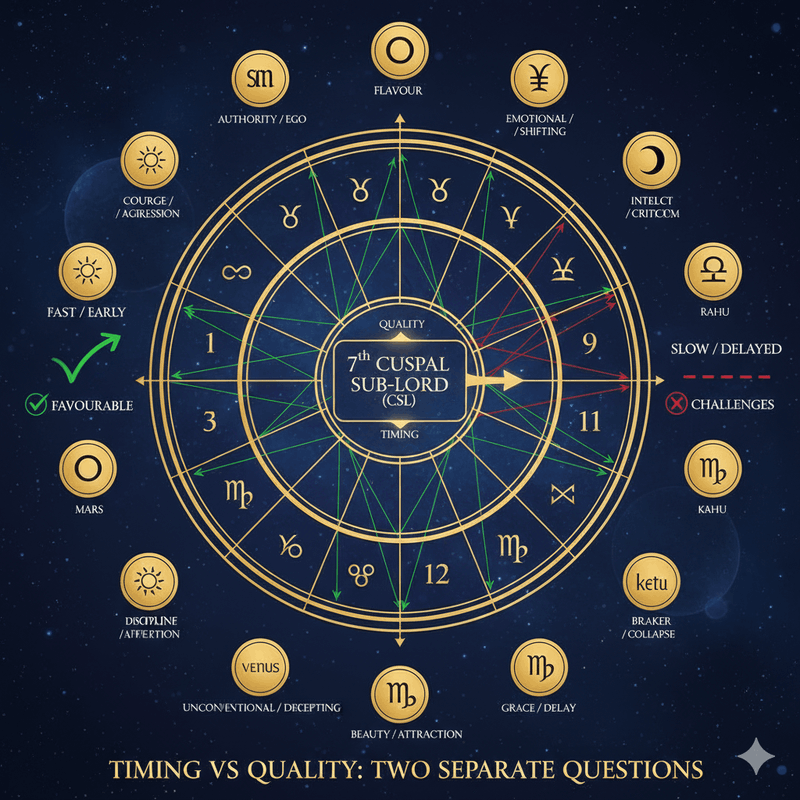
Each of the nine planets, when it becomes your 7th CSL, colours the marriage experience in its own distinct way. But here's the critical insight most people miss: the 7th CSL answers two completely separate questions.
Timing vs Quality — They Are Not the Same Thing
This is perhaps the most misunderstood principle in marriage astrology. A slow planet as your 7th CSL does not mean a bad marriage — it only means a delayed one. A fast planet doesn't guarantee happiness — it only means the event arrives quickly.
- Fast-moving planets (Sun, Mercury, Venus, Mars) — marriage comes early or on time.
- Slow-moving planets (Saturn, Jupiter, Rahu, Ketu) — marriage is delayed, sometimes significantly.
- The Moon — a special case entirely. It doesn't fit either category, and when it becomes the 7th CSL, the marriage picture keeps shifting every few years.
Quality — whether the marriage is happy or troubled — depends entirely on what houses the planet connects with through its star-lord and sub-lord. Connections to houses 1, 3, 5, 7, 9, 11 bring favourable results. Connections to 6, 8, or 12 bring challenges. The planet itself only sets the flavour.
The Flavour Each Planet Brings
Without going into the full house-level analysis (which requires an individual chart), here's a glimpse of what each planet reveals about the nature of the spouse when it sits as the 7th CSL:
Sun — Authority and prestige. The spouse carries dignity, often with a connection to government or leadership. When afflicted, that authority turns into ego and domination.
Moon — Emotional and nurturing, but unstable. The Moon is considered unsuitable for permanent houses like the 7th because it makes the relationship oscillate — wonderful one year, troubled the next. The prediction changes with every Dasa-Bukti shift.
Mars — Courage, physical strength, and protectiveness. Mars is also the Kalatra Karaka (spouse significator) for women. Positively placed, the spouse is action-oriented and protective. Negatively placed, expect aggression and power struggles.
Mercury — Intelligence, communication, and youthfulness. This is the planet of compromise and flexibility. When positive, the couple communicates beautifully. When negative, that same sharpness turns into criticism and argument.
Jupiter — God's grace, honesty, and culture. Jupiter brings divine protection to the marriage — even when problems arise, fortunate circumstances resolve them. But Jupiter is slow, so the marriage is delayed. And when Jupiter is afflicted? That divine protection disappears, which is perhaps worse than never having it.
Venus — Beauty, attraction, and intimacy. Venus has two dimensions: the outer karaka (material luxury, ornaments) and the inner karaka (physical pleasure, hormonal attraction). Both need to be in balance. There's a specific house combination with Venus that the texts explicitly warn against — it overdevelops one dimension at the expense of the other.
Saturn — Delay, discipline, and endurance. Saturn delays marriage but says nothing about its quality. A positive Saturn gives a hardworking, loyal, patient spouse. A negative Saturn brings chronic, prolonged suffering — and because Saturn moves slowly, bad periods last much longer than with any other planet.
Rahu — Foreign connections and unconventional unions. Inter-caste, inter-faith, cross-cultural marriages often show Rahu as the 7th CSL. Positively placed, this brings growth. Negatively placed, the unconventional turns into deception and hidden agendas.
Ketu — The breaker. Ketu's fundamental nature is to demolish what it touches. When Ketu is the 7th CSL, proposals come close and collapse at the last moment — repeatedly. Any planet in the star of Ketu will have its significations broken. This is one of the most important rules in KP practice.
A Case That Illustrates the Principle
Consider Saturn as the 7th CSL, placed in the star of Ketu and sub of Ketu, connected with houses 2, 4, and 6. The native searched for a marriage partner from age 27 to 40 — thirteen years. Five or six proposals came close, but every single one broke at the last moment. Ketu's demolishing nature kept shattering what Saturn was slowly building. Marriage finally happened at 40 during a favourable Dasa period.
Saturn delayed. Ketu broke. But the marriage itself, when it finally arrived, was not doomed — because the house connections did not include 8 or 12.
Timing and quality. Two separate questions. Always.
What This Doesn't Tell You
The 7th CSL reveals the public, outer dimension of marriage — the nature of the spouse, the social face of the relationship. But marriage has a private dimension too. For that, you need to separately analyse Venus (for men) or Mars (for women) as the Kalatra Karaka.
And the 7th CSL alone is never sufficient for a complete marriage prediction. A full analysis requires checking the 7th house, the Kalatra Karaka, the Lagna, the 5th, 9th, and 11th houses, and the running Dasa-Bukti period. Every layer adds precision.
No planet is inherently good or bad for marriage. Every planet can deliver a happy union if the house connections are favourable — and every planet can ruin it if 6, 8, and 12 are involved. The planet sets the flavour. The houses decide the outcome.