The Narasimha Avatar: A Boon, a Pillar and a Doorway
Every telling of the Narasimha story turns on a boon that was meant to be airtight, and on the care with which it was taken apart.
The fullest standard account sits in the seventh canto of the Bhagavata Purana, across chapters three, eight and nine. It is the frame behind every Narasimha shrine in the Telugu country, Yadagirigutta included, and it is worth having in front of you before any local legend is laid on top of it.
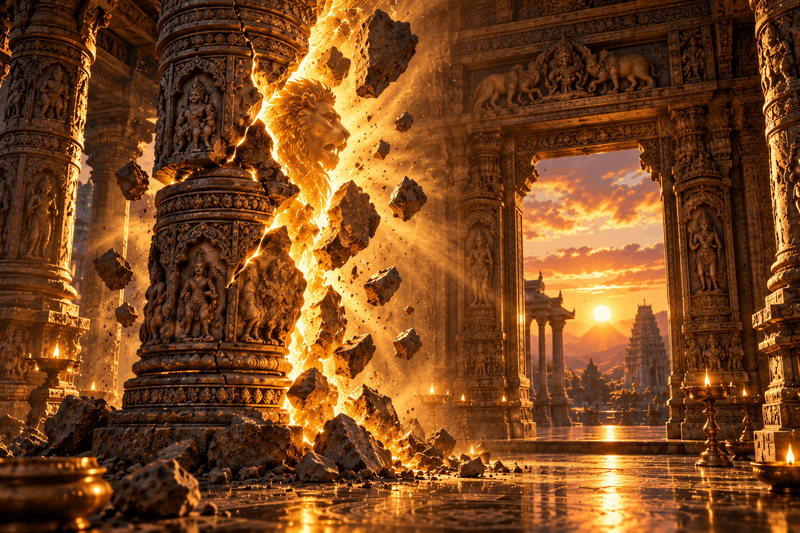
The boon, and the doors it closed
Hiranyakashipu performs severe austerities in the Mandara valley, and Brahma grants him a boon that shuts nearly every door at once. He is not to be killed by any being Brahma created. Not inside a residence, nor outside one. Not by day, nor by night. Not on the ground, nor in the sky. Not by any weapon. Not by a human and not by an animal. Not by anything living and not by anything inanimate. Not at the hands of gods, demons or the great serpents.
Read as a list it is close to total. Read as a shape it has seams, and the whole of the rest of the story is spent finding them.
The pillar
The provocation is domestic. Hiranyakashipu's son Prahlada will not stop worshipping Vishnu, and his father taunts him that if God is everywhere, then God is in the palace pillar. He strikes the pillar with his fist, and the Lord comes out of it.
One translation of chapter eight describes the form as a hybrid with golden-fiery eyes, tusks, a razor-sharp tongue, a white mane and many clawed arms, and says the crash from the pillar shakes the cosmic egg itself. Narasimha kills Hiranyakashipu in the doorway of the assembly hall, laid across his thighs, with the nails of his hand.
Each clause of the boon is answered by a condition of the kill:
- Not by human or animala form that is neither, and not among the beings Brahma made
- Not indoors or outdoorsthe threshold of the hall, which is neither
- Not by day or nightthe juncture between the two
- Not on ground or in skyacross the Lord's own thighs
- Not by any weaponthe nails of a hand
One note on that third line. The word twilight is often used for it, and it is a reasonable gloss, but it appeared in our reading only in a summary rather than in a translation of the verse. The juncture between day and night is the safer phrasing, and it carries the same force.
The aftermath is why the gentle form exists
This matters more for Yadagirigutta than the kill does, because the image at the centre of that shrine is not a fierce Lord but a calm one with his consort on his lap.
In the Bhagavata's ninth chapter the gods led by Brahma cannot approach the enraged Lord. Neither can Lakshmi, who has never seen such a form. Brahma sends the boy Prahlada forward instead, and at the sight of the prostrate child the Lord grows affectionate and rests his lotus hand on the boy's head. That is the Bhagavata's resolution: the fury is ended by the child it was raised for.
The motif of Lakshmi herself soothing the Lord is a different strand, which Wikipedia attributes to the Padma Purana rather than the Bhagavata, and it is that strand which gives Lakshmi Narasimha his standing as a gentle form. The same reference work says the fierce Ugra Narasimha became the peaceful Soumya form after Prahlada's prayers, and that seventeen Puranas mention the avatar in some form.
Tradition at Yadagirigutta assumes the gentle resolution and builds on it. It is worth knowing that the two tellings reach it by different routes, and that the Lakshmi version is not the one in the canto most often cited.
What the other texts do and do not carry
The abridged Vishnu Purana we read treats the episode very briefly. It closes its first book with Prahlada surviving weapons, snakes, elephants, fire, poison and drowning, and mentions the man-lion only in passing. A reader who goes there expecting the pillar will not find much of it.
There is a Narasimha Purana, dated by Wikipedia to the late fifth century with later additions. We did not confirm its own telling of the story against an edition, so nothing here rests on it.
Which age this happened in is not settled
Treta Yuga is the second of the four ages: 3,600 divine years, or 1,296,000 human years, inside a cycle of 4,320,000. Rama belongs to Treta, so a legend that opens "in the Treta Yuga" is placing itself in Rama's age — which is what makes Hanuman available to a story, and Hanuman is in several of the Yadagirigutta tellings.
The avatar's own age is a looser matter. Our sources do not fix it. One Telugu portal places Narasimha's arrival in the Dandakaranya region after the kill, in the Krita Yuga, which would make the Lord's settling on the hill older than the sage's penance rather than a response to it. Only that one source says so, and nothing else we read contradicts or confirms it.
That is the frame. What a particular hill does with it — who saw him there, in how many forms, and on whose account — is a separate kind of claim, and at Yadagirigutta it is told in at least seven different ways.
Reckoning the days
The kill happens at the juncture of day and night, and in this reckoning that juncture is a computed thing rather than a loose one. Sunrise, sunset and the divisions between them are the base of the whole system.
Our panchang app, Navashi, computes that layer for any date and any place: tithi, nakshatra, yoga and karana, the day’s muhurats, choghadiya and hora, and the festival calendar with start and end timings rather than a single date. It carries eight traditions, not one.
- iPhone and iPadNavashi on the App Store
- AndroidNavashi on Google Play