Every Planet Has Two Faces: Inner and Outer Karakas of the Navagrahas
The previous article showed that every house in a horoscope carries two types of significations — inner karakas tied to body, mind, and feelings, and outer karakas tied to money, materials, and the external world. The house that dominates your chart determines not just what happens in your life, but which face of that life area you experience most.
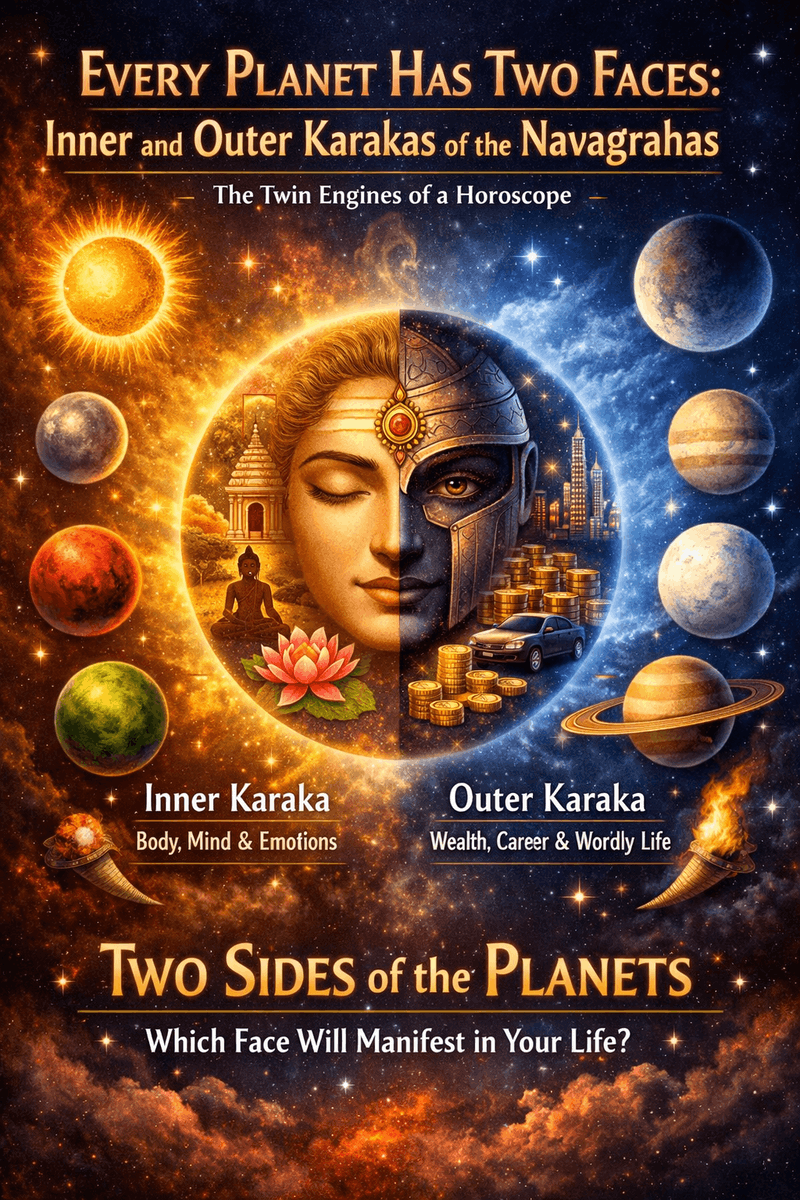
Planets carry the exact same duality.
Every planet in astrology has significations that depend only on the native's body — and significations that depend on the native's interaction with the world. Which face manifests is not random. It is determined by which houses the planet connects with through its star lord and sub lord. The same planet can protect your health or build your career — but rarely both at full strength simultaneously.
This article walks through the planetary inner–outer split, planet by planet, and then shows you the mechanism that decides which face shows up.
The Same Coin, Different Metal
In the previous article, we used the analogy of a coin — each house has an inner face and an outer face. Planets work the same way, but with a twist.
A house's karakas are fixed to a domain of life — the 7th house will always be about partnerships, the 10th about profession. A planet's karakas, however, travel with the planet across all domains. Sun represents the brain whether it is connected with the 1st house or the 10th house. But whether that brain-karaka manifests as good health (inner) or professional leadership (outer) depends entirely on the house connections.
Think of each planet as an employee with two skill sets — a personal skill set (things they do for themselves) and a professional skill set (things they do for others). The department they are assigned to determines which skill set gets used.
Planet by Planet: The Two Faces
Sun — The Administrator
Sun's inner karakas are bones, brain, heart, eyes, soul, immunity power, and temperature regulation. These exist entirely within the native's body. No one else can experience your bone strength or your brain function.
Sun's outer karakas are administrative capacity, leadership, government cooperation, fame, and chief post. These require interaction with others — you cannot be a leader in isolation, and government cooperation is by definition an external affair.
Sun is the clearest example of the inner–outer split because its two faces are so distinct. A healthy brain (inner) and a powerful leadership role (outer) are both Sun's karakas, but they operate in completely different dimensions of life.
Moon — The Nurturer
Moon's inner karakas are the entire human body (since blood circulates everywhere), blood pressure, mental state, thoughts, emotions, and psychological stability. Moon is the Manokaraka — the planet of the mind. Everything it governs on the inner side is invisible to others. Your blood pressure, your emotional turbulence, your racing thoughts — these are private experiences.
Moon's outer karakas are food, cooking, hospitality, hotels, water-related industries, logistics, transfer, and rapid change in professional settings. These are tangible, external, and often commercial. A hotel business, a food distribution chain, a transfer order — all Moon's outer domain.
The gap between Moon's two faces is striking. On the inside, Moon governs the most intimate aspects of human experience — mood, mental health, emotional bonds with mother. On the outside, it governs some of the most fast-moving commercial activities — food that spoils quickly, logistics that demand speed, hospitality that requires constant turnover.
Mars — The Warrior
Mars's inner karakas are muscles, physical strength, blood (specifically red blood cells and hemoglobin), bone marrow, and courage as a felt experience. These are body-bound — your muscle fiber, your blood count, your personal bravery.
Mars's outer karakas are police, military, engineering, construction, fire service, competition, and hands-on physical work. These involve interaction with the world — you cannot be a police officer alone, and construction requires materials, sites, and teams.
Mars is the planet where inner strength directly fuels outer achievement. A native with strong Mars inner karakas (physical vitality, courage) often excels in Mars outer domains (military, sports, engineering). But the system doesn't guarantee both — a Mars connected with odd houses may give excellent health and courage without the career opportunities, while a Mars connected with even houses may give a demanding physical career that gradually strains the body.
Mercury — The Communicator
Mercury's inner karakas are the nervous system, intelligence, analytical capacity, speech mechanism, and skin. These are personal faculties — your ability to think, to process information, to articulate.
Mercury's outer karakas are IT, software, communication technology, accounting, business transactions, writing, printing, advertising, and electricity. These are industries and activities that exist in the commercial world.
Mercury is the bridge between thought and transaction. On the inside, it governs how you think. On the outside, it governs the infrastructure through which thinking becomes commerce — the software that processes data, the networks that carry communication, the accounts that track money.
Jupiter — The Teacher
Jupiter's inner karakas are wisdom, spiritual knowledge, faith, optimism, liver function, fat metabolism, and the body's energy management system. These are internal — your faith is yours alone, and your liver doesn't negotiate with anyone.
Jupiter's outer karakas are teaching, consulting, banking (particularly legitimate/white money channels), spiritual institutions, temples, judiciary, law, and higher education. These are social and institutional — a teacher needs students, a judge needs a court, a banker needs depositors.
Jupiter is the planet of expansion, and its two faces show what gets expanded. On the inner side, wisdom, faith, and bodily energy expand. On the outer side, institutions, knowledge systems, and financial structures expand.
Venus — The Artist
Venus's inner karakas are the reproductive system, sexual hormones, beauty, physical attractiveness, sensory pleasure, and the experience of luxury and comfort. These are felt by the native — your sense of beauty, your physical desires, your experience of comfort.
Venus's outer karakas are the entertainment industry, arts, dance, music, vehicles, jewellery, beauty products, perfumes, and luxury goods trade. These are commercial and performative — an artist performs for an audience, a jeweller sells to a customer, a vehicle manufacturer builds for a market.
Venus illustrates the inner–outer trade-off vividly. A native who enjoys Venus's inner karakas fully (physical beauty, sensory pleasure, romantic satisfaction) may not convert those qualities into commercial success. A native who excels in Venus's outer karakas (entertainment career, beauty industry, vehicle trade) may find their personal sensory life less fulfilling. The horoscope's house connections determine which face dominates.
Saturn — The Laborer
Saturn's inner karakas are the skeletal structure (particularly knees and joints), tendons, chronic pain, aging, endurance, and the experience of loneliness, restriction, and delayed gratification. These are deeply personal — your knee pain, your sense of isolation, your patience.
Saturn's outer karakas are lower-level employment, hard labor, night shifts, petroleum engineering, mining, iron and steel, leather, old or used goods, and structured hierarchical organizations. These are the unglamorous but essential engines of the material world.
Saturn's two faces share a common thread: heaviness. On the inner side, the body feels heavy — joints ache, aging takes its toll, emotions run toward melancholy. On the outer side, the work is heavy — physical labor, night shifts, petroleum extracted from deep underground. The planet is consistent in its character across both faces.
Rahu — The Foreigner
Rahu's inner karakas are fear, anxiety, obsessive thinking, confusion, hallucination, phobias, and unconventional psychological patterns. These are mental and emotional disturbances that happen entirely inside the native's experience.
Rahu's outer karakas are foreign travel, international business, aerospace, large-scale machinery, unconventional professions, technology that crosses borders, and anything involving rule-breaking or boundary-crossing in the material world.
Rahu's duality is between internal chaos and external expansion. On the inside, Rahu creates psychological turbulence. On the outside, it creates extraordinary opportunities — but always in domains that are foreign, unconventional, or outside the native's cultural comfort zone.
Ketu — The Detacher
Ketu's inner karakas are spiritual detachment, intuition, psychic sensitivity, past-life impressions, and the experience of liberation or disconnection from worldly desire. These are the most private of all inner karakas — they exist in the deepest layers of consciousness.
Ketu's outer karakas are investigation, secret intelligence, CID and undercover work, occult practices, alternative medicine, and professions that involve going beneath the surface of things.
Ketu inverts Rahu's pattern. Where Rahu expands outward into the foreign and unknown, Ketu contracts inward toward the hidden and the already-known (from past lives). Its outer face involves uncovering what is hidden; its inner face involves experiencing what is beyond the material.
The Master Principle
There is a sentence in the foundational texts that captures everything this article has covered:
Every planet activates the bhava karakas of its interlinked bhavas through its graha karakas, and at the same time negates through its graha karakas of the 8th and 12th from those interlinked bhavas.
Read that twice. It means:
When Sun connects with the 10th house, Sun's graha karakas (leadership, administration) express themselves through the 10th house's bhava karakas (profession, prestige). The native gets a leadership position in their career. But simultaneously, Sun also negates — the 8th and 12th from the 10th house (which are the 5th and 9th from Lagna) suffer through Sun's karakas. Entertainment and fortune take a hit while the career thrives.
This is why no planet produces a purely positive or purely negative result. Every activation comes with a simultaneous negation. Every gain has a corresponding cost. The horoscope is not a list of blessings and curses — it is a ledger of trade-offs, and the inner–outer karaka framework is the accounting system that tracks them.
The ultimate receiver of all these trade-offs is the Lagna — the native. Whether the trade-off is acceptable or devastating depends on which face of which planet is active, and which houses absorb the negation.
What Comes Next
You now understand that both houses and planets carry two faces — inner and outer — and that the house connections determine which face manifests. But we haven't yet answered a more fundamental question: how does a planet acquire its house connections in the first place?
The next article answers that. It introduces the Source–Matter–Decider framework — the star lord and sub lord system that transforms every planet from a static symbol into a dynamic actor in the horoscope. That transformation is the engine that makes prediction possible.
This article is part of an educational series on astrology concepts. No real horoscope data has been used. All examples are illustrative.